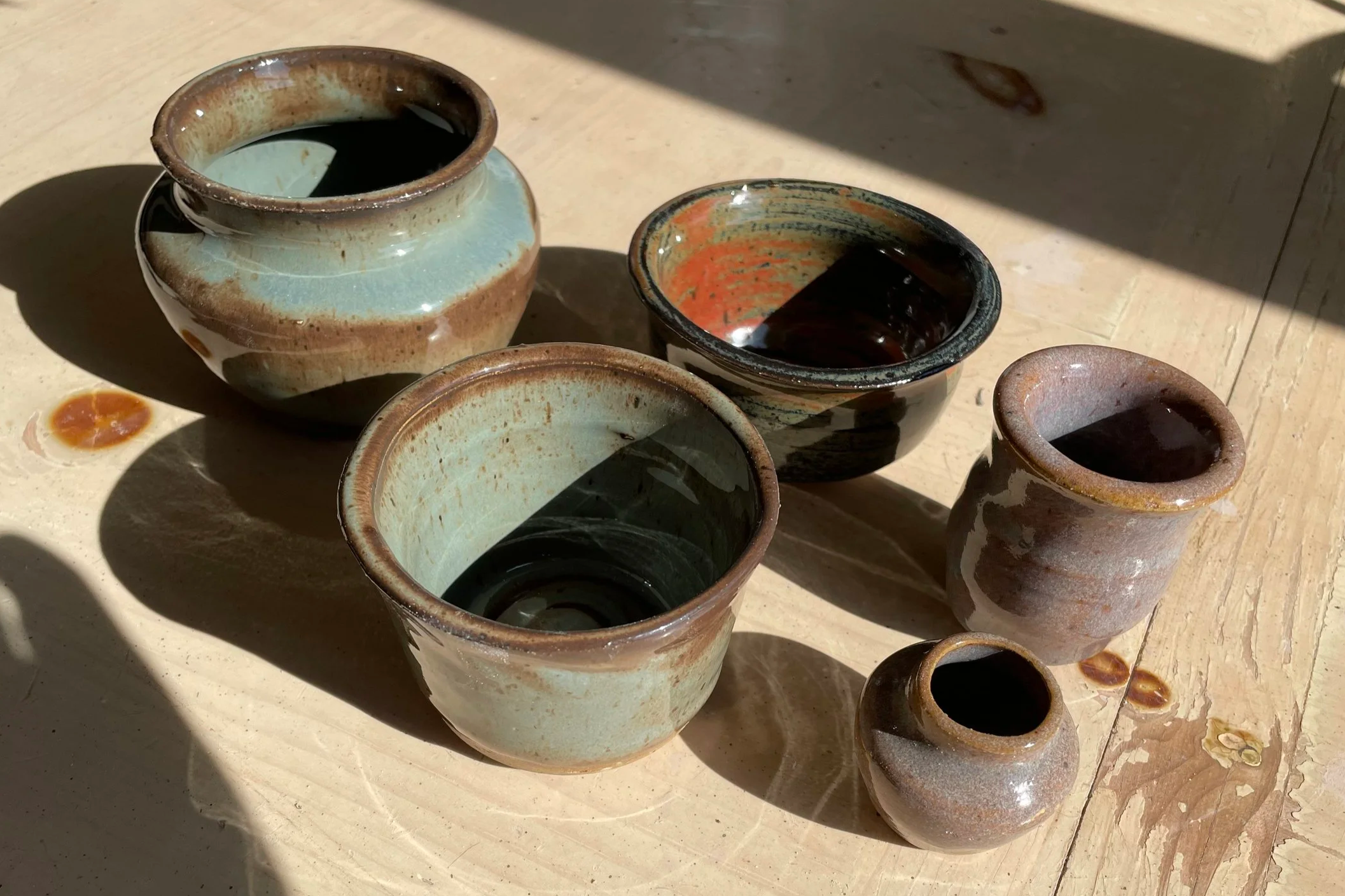
Beginner Wheel-Throwing Guide
Beginner Wheel-Throwing Guide
This guide breaks down very basic wheel throwing for a beginner.
Basic Steps of Throwing on the Pottery Wheel for Beginners
SET-UP
Water, sponge(s), one Rib, wooden knife, needle tool, wire cutter, towel, apron, several 1 to 1.5lb of de-aired or wedged clay rolled into balls.
Sit as close to your wheel as possible, place the footpedal in a position that keeps your body as symmetrical as possible. Place your foot on the pedal with your foot in the heal-down position before turning the wheel on.
CENTER THE CLAY
Wheel Speed: High to Medium High
Place a ball of clay in the center of the wheel. Hold the clay with your non-dominant hand and smack it a few times with your dominant hand.
Seal the edges of the clay to the wheel
Add water to the clay and wet your hands.
Elbows must be secured into your body or thigh. Keep your back straight.
Push the foot petal to high or medium-high speed. Lock your elbows into your body and push the clay down and away from you.
Counter clockwise wheel (US-EU or Right Handed Students) - right hand holds a sponge filled with water loosely in the palm making a soft fist (do not squeeze the sponge you want it dripping). This hand pushes downward on the clay. The left hand is pushing the clay away at an angle to create a rounded cone shape away from your body.
Clockwise wheel (Asia or Left handed Students) - Lefthand holds a sponge filled with water loosely in the palm making a soft fist (do not squeeze sponge you want it dripping). This hand pushes downward on the clay. The Right hand is pushing the clay away at an angle to create a rounded cone shape away from your body.
IMPORTANT - If you are exfoliating the lower part of your hand that is pushing away it means you are pushing down onto the wheel-head and not horizontal to the clay. Angle your hand so that you leverage the muscle below your thumb more to keep the clay from rising.
Drip water as needed - do not allow the clay to get dry. Focus your energy into the clay by stabilizing your body. Do not allow your elbows or body to wiggle. Helpful hint: Lock your arms into your body and use your core to push the clay- not your arms.
OPEN THE CLAY
Wheel Speed: Medium to Medium High
Always use both hands together for control. Find the center of the clay, press down until you make a well. Add water to the well, push down checking to be sure you have not gone too far. Do not allow your fingers to wiggle.
If your fingers wiggle STOP, re-Center your clay with a finger in the middle where the hole was made before continuing. (or ask for help)
Leave at least one centimeter on the bottom of your pot.
Check the depth of your bottom by stopping the wheel and using the needle tool. Push through the clay on the bottom to learn how thick the clay is.
CREATE THE FLOOR
Wheel Speed: Medium to Medium High
Pull the wall towards you with the same fingers you made the hole with.
Use lateral pulling only - floor should be flat not rounded or bumpy.
Compress the floor by either:
Using your finger(s) at the side of the wall and gently pushing downward to the middle without removing clay or…
Using a rib
Compressing can be repeated when done correctly.
PULL UP THE WALL
Wheel Speed: Medium to Slow as walls get thinner
The inside hand is always above the outside hand.
Always keep your hands on the side of the clay that allows the clay to move through your hand and out your fingertips.
Counterclockwise wheel rotation - Lefthand inside placed between 3 o’clock and 6 o’clock on the wheel.
Clockwise wheel rotation - Righthand inside placed between 9 o’clock and 6 o’clock on the wheel.
Try to keep both hands touching to maintain control. Examples:
Butterfly thumbs together
One thumb touches the opposite hand or
Keep wrists touching
Keeping your fingers in position, use your body or arms to lift the clay.
Your hands need to move slowly even though the wheel is faster. The wheel should rotate a minimum of 2 to 3 rotations for each incremental change as you raise the wall.
As you near the top- if done correctly your inside hand will come off the clay! Continue to throw the last portion of clay with just your outside hand again - gentle and slow 3 rotations for each incremental move up.
Keep your hands steady and slow- no jerky, sudden movements or your pot will be off center..
Repeat steps above trying to achieve a taller centered cylinder each time.
CLEAN THE FOOT
Wheel Speed: Medium to Slow
Place your non-dominant hand on the foot (bottom) of your pot touching the pot as it rotates slowly. Take the wooden knife in your dominant hand and place it with the sharp point downward on the wheel-head so that it can be pushed into the bottom of the pot as the wheel rotates.
The wooden knife and your fingers will pick up excess clay by-passing the wooden knife and will create a small groove for the wire-cutter to smoothly cut the pot off the wheel.
RELEASING AND REMOVING YOUR POT
Wheel Speed: Off or Slow
Hold the wire cutter in both hands ensuring the wire is taught between your hands. Press the wire down on the wheel-head and pull the wire under your pot while keeping it taught on the wheel.
Note: sometimes you may need to wrap the wire around your fingers to make it shorter.
Use both hands to gently lift your pot off the wheel OR Use pot lifters to help you remove your pot off the wheel.
Place your pot on a board appropriate to its size or to the amount of work you plan to create in one sitting. Cover the pot with plastic ensuring your name is taped on the plastic before placing it on a shelf to slowly dry.
This guide is designed to provide the simplest steps possible for a beginner to gain a solid foundation on the potter's wheel. It is designed to provide basic best practices that will help a student avoid bad habits. Once students are able to consistently produce a tall cylinder without limiting habits additional steps and options can be introduced.